

Monday, April 23, 2012
Chapter 12: Islam - People of the Book

Sunday, April 22, 2012
Chapter 18: Wicca - Old Pagan Religion Renewed
Subject Labels:
Inquisition,
Mother Goddess,
Neo-Paganism,
Phenomenology of World Religions,
Wicca,
Witchcraft

Wicca is a
modern neo-pagan religion that is based upon an ancient pagan religion
that was common among the Celts of northern Europe, and in Britannia
(so named by Julius
Caesar who conquered and made it part of the Roman Empire)
where the mystic cult of Druidism originated based upon the “Mother”
fertility goddess whose consort was a horned god. It is a mystery
religion that has different theological concepts or denominations,
some monotheist, original goddess worship, such as the Dianic
Wicca, Cochrane's
Craft, and polytheism. Denominations are considered
traditions within the Wiccans: Gardnerian
and Alexandrian
Wicca follow the concepts of Gerald
Gardner.
Saturday, April 21, 2012
Through the Looking Glass: Religious Perspective
Subject Labels:
Islam,
Islamic Fascism,
Religious Intolerance,
Religious Tolerance,
Theology in the News
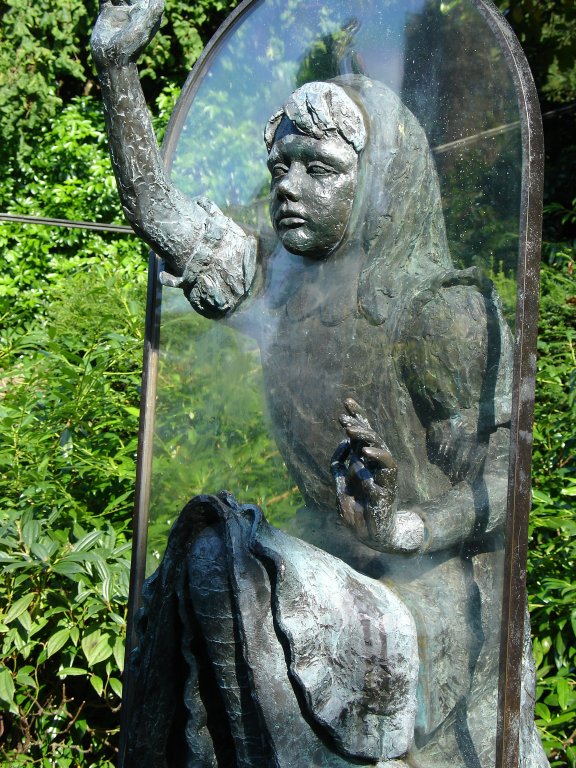
The classic literature of Lewis
Carroll (birth
name: Charles
Dodgson)
has gone down through the ages reprinted into books,
plays, and films. It began with the book Alice's
Adventures in Wonderland in
1865, which was followed by Through
the Looking Glass and What
Alice Found There in 1871.
Through the Looking Glass
was about a world beyond a mirror (looking
glass). If one looks into a
mirror one sees a reflection that appears reversed; however, if one
was looking from within or the other side of the “looking glass”
it would be a natural view. As with the mirror, Alice's Adventures in Wonderland is filled with symbolism – a world remarkably different
than reality, and a world where nothing is as it seems.
Sunday, April 8, 2012
Easter Message: April 8th 2012
Today is Easter Sunday.

I want to put out something brief and
get back to family activities.
It is disturbing to know that some
people believe Jesus
was a “Commie”. Apparently they have not learned in
school just what Marxism is.
But after examining today's textbooks, I
can see why.
To fellow Christians and anyone: I wish you blessings and peace as you spend
time with your families this weekend.
From Gospel
of Matthew 28:1-9 …
1 In the end of the sabbath, as it began to dawn toward the first day of the week, came Mary Magdalene and the other Mary to see the sepulchre. 2 And, behold , there was a great earthquake: for the angel of the Lord descended from heaven, and came and rolled back the stone from the door, and sat upon it. 3 His countenance was like lightning, and his raiment white as snow: 4 And for fear of him the keepers did shake , and became as dead men. 5 And the angel answered and said unto the women, Fear not ye: for I know that ye seek Jesus, which was crucified . 6 He is not here: for he is risen , as he said . Come , see the place where the Lord lay . 7 And go quickly, and tell his disciples that he is risen from the dead; and, behold , he goeth before you into Galilee; there shall ye see him: lo , I have told you. 8 And they departed quickly from the sepulchre with fear and great joy; and did run to bring his disciples word . 9 And as they went to tell his disciples , behold , Jesus met them, saying , All hail . And they came and held him by the feet, and worshipped him.

Monday, March 19, 2012
Religious Tolerance: Policy of Obama and Progressives
Subject Labels:
Christianity,
First Amendment,
intolerance,
Media Bias,
persecution,
Religious Tolerance

Rarely will you see anything written
concerning politics here at Veritas et Theologium;
however, when government intervenes upon religious rights and the
First Amendment – it is another matter.
In January of 2012, Barack Obama's
Department of Health and Human
Services announcement requirement of all employers to offer
insurance coverage of sterilization,
abortifacients and contraceptives without deductible or co-pays in
their employee plans by August 1st, 2012.
Churches are exempt; however,
Catholic-funded hospitals, schools or other charity organizations are
not exempt.
Archbishop,
soon Cardinal Timothy
Dolan, New York, leader of the US
Council of Catholic Bishops stated:
The government should not force Americans to act as if pregnancy is a disease to be prevented at all costs. Historically, this represents a challenge and a compromise of our religious liberty.
Saturday, March 17, 2012
Chapter 20: Christology: Unitarianism
Subject Labels:
Calvinism,
Christology,
Early Christianity,
Heresy,
Phenomenology of World Religions,
Unitarianism
Phenomenology
of World Religion
Chapter
20 ©
[Christology: Unitarianism]
[Christology: Unitarianism]

Unitarianism is a proper noun in
English that is a religious “ism” movement like Calvinism,
Anabaptism,
Adventism,
Wesleyanism,
Protestantism,
Catholicism,
and so on. It is a sect of Protestantism (that is a sect of
Catholicism). One can readily see that Christianity, for all
its similarities between sects and theological diversity is one of
the most complex to understand the differences, despite being based
upon the identity of Jesus (the Galilean) from Nazareth, known as
Christ.
In the case of
Unitarianism, it is a actually a description of several forms
of Christianity; and can be described as the belief that God is one
personality. That is the main difference between the major sects
theological thought in what is called Trinitarianism.
Monday, January 30, 2012
"Christophobia" Rhetoric: Politics as a Religion

What is Islam? Is the barbarity of September 11 rooted in the preaching of Muhammad? Or are the Islamists, the Islamic fascists, bent on the destruction of all who disagree with them, merely an aberration, mixing politics, religion and violence in an appeal to the lowest psychological denominators of suicide bombers? Historians, political scientists and psychologists are all over the place in supplying answers to these questions. … The historical forces at play are obvious. Bernard Lewis, a leading scholar of Islamist rage, places the fault line at the failure of the Muslim world to keep up with the West in the modern world. Diminishing Muslim power is both a humiliation and in Muslim minds a reversal of divine law, driving the losers to pick through the verses of the Koran to find justification for violence against winners. … Other scholars blame Western colonialism and imperialism, along with Judeo-Christian traditions, as contributing to the violent mentality of the extremists. These aberrations, they say, cannot be found in the teachings of Muhammad. … Islamists distorted this phenomenon for their own malevolent ends, fusing politics and religion into an all-purpose aggression for the “long-suffering victims” of Western imperial expansion. But there’s another view. “The Middle East’s experience is the culmination of long-existing indigenous trends, passions, and patterns of behavior, first and foremost the region’s millenarian imperial tradition,” writes Efraim Karsh, a British scholar, in “Islamic Imperialism,” a provocative and persuasive book. … He looks directly to the words of Muhammad, who in his farewell address to his followers ordered them to fight all men until they submit with the assertion that “There is no god but Allah.” … Muhammad proselytized with violence and used violence to consolidate conquest. Occupying territory was as important as converting or killing unbelievers. When the Jews of Medina resisted Muhammad in the 7th century, he beheaded the men and sold their women and children into slavery. The prophet, who claimed to derive his power and authority from Allah, was not only head of the captured states but was the single religious authority. “This allowed the prophet to cloak political ambitions with a religious aura,” writes Mr. Karsh, a professor at the University of London, “and to channel Islam’s energies into its instrument of aggressive expansion.” The ultimate goal would be for the world either to embrace Islam or live under its domination. This goal was realized in part with the establishment of the Ottoman Empire, which allowed certain other religions to exist but not prosper. Christians who sought domination, on the other hand, never invoked the teachings of Christ to justify violence. … The interpretation of the Islamist mentality as rooted in Muhammad’s appeal to violence, and the Islamist determination for religious domination of the world, may not tell the whole story today, but it explains why, for millions of Muslims, the image of the warrior trumps the image of a prophet of peace – if, indeed, there ever was one.
Subscribe to:
Posts (Atom)